
One protected wallet for all of it
All the security in this series protects an ordinary, complete wallet. You should not have to give up networks, swaps or bridges to keep your keys offline.
On this page
Networks
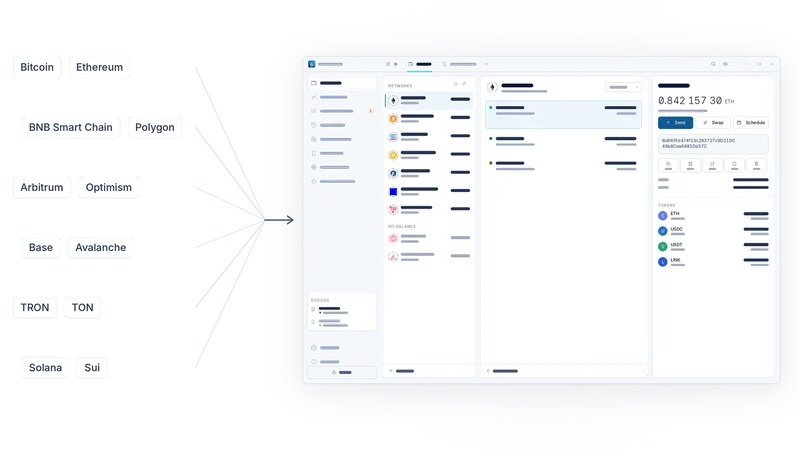
Bitcoin, Ethereum and its major L2 networks, BNB Smart Chain, Polygon, Arbitrum, Optimism, Base, Avalanche, Gnosis, Linea, Mantle, TRON, TON, Solana and Sui are built in, with their test networks. A new network does not need a new version of the wallet: networks are described by a manifest, and you can add a custom one yourself.
Each chain family has its own derivation, address formats, fee model and transaction format, and the wallet speaks each natively. There is no generic layer pretending a Solana transaction is an Ethereum one.
Wallets and addresses
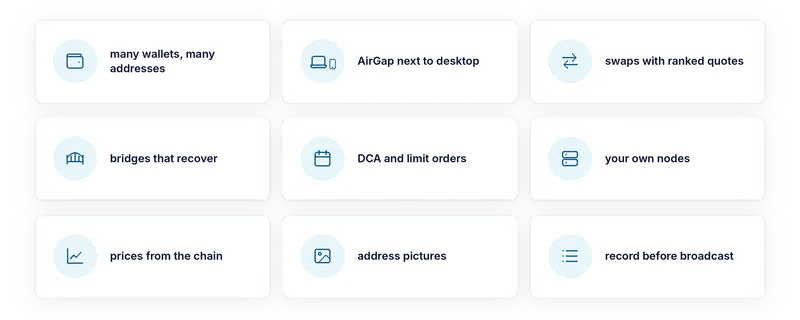
A wallet is a seed. You can keep as many as you like, each for its own purpose, each unlocked with the same password. Within a wallet you derive as many addresses as you need per network, give them labels, and group them. Watch-only wallets let you follow an address without holding its key. An address book keeps the places you send to, with names.
AirGap next to a desktop wallet
A wallet whose seed lives on the desktop, sealed in the vault, is the right tool for frequent operations. It signs in the wallet window after the same screening, with no phone to reach for. An air-gapped wallet, whose keys live on the phone, is the ultimate protection for the funds that matter most. Both sit in the same window, with the same history and the same address book. Only the signing path differs, and the wallet shows you which is which.
Swaps, ranked
A swap asks several aggregators and routers for a quote at once, compares them, and ranks them so the best one is at the top with the others visible. Each swap has an explicit allowance policy: approve exactly this amount, a total you set, a maximum, or reuse an existing allowance. The approval target is checked against the router that gave the quote. Unlimited approvals are never the silent default.
Bridges that recover
Cross-chain transfers go through established bridge protocols, including routes between EVM networks and TON. A bridge transfer is several steps on two chains, and things can stall between them. The wallet keeps a journal of each bridge operation and picks it up where it stopped, so a closed laptop mid-transfer is an inconvenience, not a loss.
DCA and limit orders
Recurring buys run on a schedule you set. Limit orders trigger on a price taken from on-chain data rather than from an exchange feed, so there is no off-chain service deciding when your order fires.
Your own nodes
The wallet ships with curated default endpoints and lets you override them per chain with your own node. Behind that is a router that spreads requests across endpoints, fails over when one misbehaves, and rests an endpoint that keeps failing. All connections use modern transport security.
Prices from the chain
Rates come from on-chain oracles and decentralised exchange data, not from a price API that would see your addresses with every refresh. Your balances are computed with prices you can verify, by a wallet that did not tell anyone what it was looking up.
Address pictures
Every address is given a deterministic picture, shown on the desktop and on the phone. Two addresses that share their first and last characters, the classic look-alike attack, get obviously different pictures. Your eye catches what hex does not.
Record before broadcast
A sent transaction is written to the wallet's journal before it is broadcast. Kill the app mid-send, lose power, pull the plug: the record is there, and the wallet resumes from it. Nothing you signed is ever lost between the signature and the network.
And the rest
A tray mode with privacy-masked notifications. Address labels, folders and search. Transaction history with human-readable dates. Multiple languages. A graceful shutdown that wipes secrets from memory. None of it is exotic. All of it is what you expect from a wallet you use every day, with the security of the series behind it.
The whole series
- Assume the computer is compromised
- Mass Adoption Security: the signer is a phone you already own
- Three ways across the gap: QR codes, Bluetooth LE and NFC
- Invisible on the air: a signer nobody can scan for
- The transport is never trusted
- What the phone shows you: transaction analysis on the signer
- The phone keeps its own record
- The vault on your desktop: Argon2id and a profile that resists guessing
- dApps without a browser wallet
- An MCP server with rules: AI agents under limits
- One protected wallet for all of it
- Small and native: C++, no JavaScript runtime, from a workstation to a Raspberry Pi